Unlock adverbial clauses of time and condition with this complete guide! These essential grammar structures—like “when,” “if,” and “unless”—add precision to your sentences. Perfect for students and competitive exam prep, explore 100 examples, pro tips, and FAQs to boost your English skills fast. Start mastering them today!
Introduction to Adverbial Clauses of Time and Condition
Adverbial clauses of time and condition are powerhouse tools in English grammar. They describe when actions happen or under what conditions, using connectors like “when,” “if,” “until,” and “unless.” Mastering adverbial clauses of time and condition helps you write clear, sophisticated sentences—crucial for essays, competitive exams like SSC, and everyday communication. This guide delivers 100 examples, tips, and FAQs to make them stick.
What Are Adverbial Clauses of Time and Condition?
Adverbial clauses act like adverbs, modifying verbs, adjectives, or other adverbs.
- Time clauses signal timing (e.g., “before,” “after,” “while”).
- Condition clauses set “if-then” scenarios (e.g., “if,” “provided that”).
They always start with a subordinating conjunction and can’t stand alone. Use them to link ideas smoothly, elevating your writing from basic to pro-level.
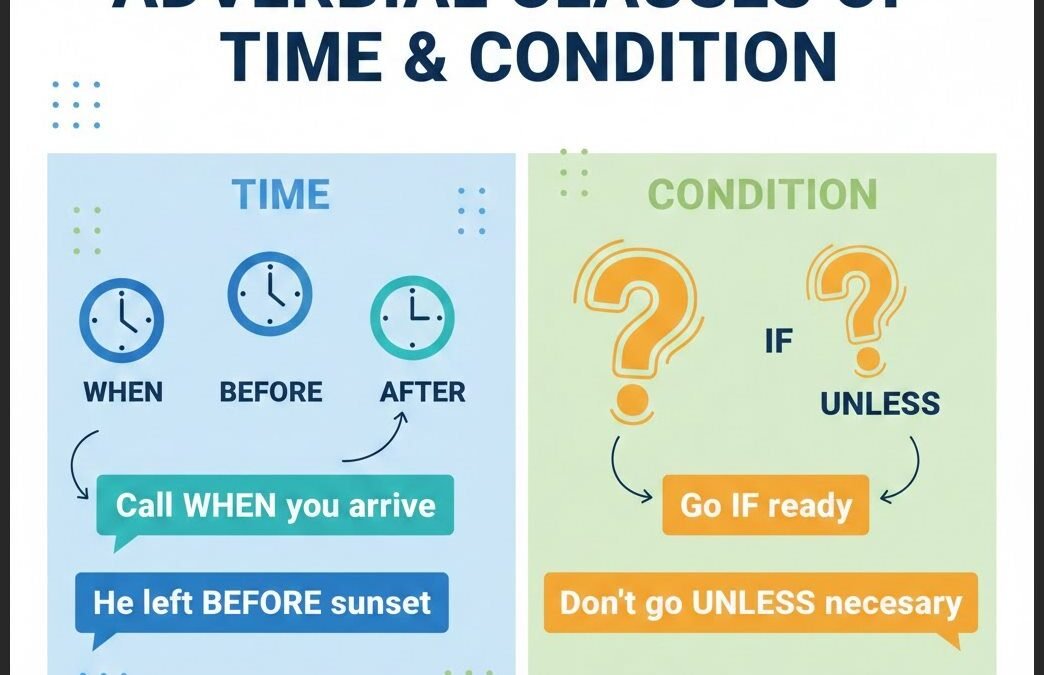
Key Connectors for Adverbial Clauses of Time and Condition
Common triggers include:
| Type | Connectors | Example Snippet |
|---|---|---|
| Time | when, while, before, after, as soon as, until, since | “Call me when you arrive.” |
| Condition | if, unless, provided that, as long as, in case | “We’ll go if it rains.” |
Pro tip: Place the clause at the start or end of a sentence, comma needed if it leads.
100 Examples of Adverbial Clauses of Time and Condition
Here are 100 practical examples, split into time (1-50) and condition (51-100). Use them for practice!
Time Clauses (1-50):
- I’ll wait here until you finish your homework.
- She smiled when she saw her old friend.
- Close the door before you leave the room.
- We’ll start the meeting after everyone arrives.
- He has been working here since last year.
- Call me as soon as you get home.
- While it was raining, we stayed indoors.
- They danced as the music played.
- By the time we reached, the show had ended.
- Once you learn this, grammar will be easy.
- I’ll phone you whenever I need help.
- The lights went out while we were eating.
- Finish your work before dinner time.
- She cried after hearing the bad news.
- We’ve known each other since childhood.
- Leave now so that you don’t miss the bus.
- As soon as the bell rings, line up.
- He slept until the alarm woke him.
- They played outside while it was sunny.
- Visit us whenever you’re in town.
- The cake will be ready before noon.
- We laughed after watching the comedy.
- She has lived abroad since 2020.
- Hurry up before the store closes.
- I’ll text you as soon as I land.
- While he studied, she cooked dinner.
- The team celebrated when they won.
- Drive carefully until you reach home.
- We met every day since summer started.
- Shout if you need help before it’s too late.
- After the rain stops, we’ll go out.
- He waited patiently while the doctor examined him.
- Call back when you’re free.
- She traveled often before settling down.
- The event begins as soon as the host arrives.
- We stayed up until midnight.
- Plants grow faster since the rains came.
- Leave the keys where you found them.
- They argued while others slept.
- Finish this first before moving on.
- I’ll join you whenever possible.
- The baby cried after waking up.
- He’s been happy since his promotion.
- Watch closely as I demonstrate.
- We’ll proceed once approved.
- She reads every night before bed.
- The power returned after hours of outage.
- Come early so we can chat.
- He jogs while listening to podcasts.
- Text me when you wake up.
Condition Clauses (51-100):
51. If it rains, we’ll cancel the picnic.
52. You won’t pass unless you study hard.
53. We’ll help provided that you ask nicely.
54. Stay here as long as you like.
55. Pack an umbrella in case it pours.
56. She’ll come if you invite her properly.
57. Don’t go out unless I say so.
58. The deal works only if everyone agrees.
59. He’ll succeed provided he persists.
60. Call me in case of emergency.
61. You can borrow it as long as you return it.
62. We’ll win if we play our best.
63. Leave now unless you want trouble.
64. Study daily provided the schedule fits.
65. Take water in case you get thirsty.
66. She dances if the music is good.
67. No entry unless you have a ticket.
68. Help arrives as long as we signal.
69. He’ll fix it provided tools are available.
70. Wear a helmet in case of falls.
71. They’ll approve if documents are complete.
72. Don’t touch unless told.
73. Party on as long as it’s safe.
74. Success comes if you believe.
75. Backup files in case of crashes.
76. She’ll join unless she’s busy.
77. Funds release provided reports are filed.
78. Drive slow in case kids play nearby.
79. We eat out if it’s a holiday.
80. No refunds unless faulty.
81. He’ll teach as long as students listen.
82. Cancel if weather worsens.
83. Pay now unless extending.
84. Lights on provided power holds.
85. Save now in case prices rise.
86. They laugh if jokes land.
87. Stay unless called.
88. Works if plugged in right.
89. Rewards given as long as rules followed.
90. Alert me in case of delays.
91. Crops grow if rains come.
92. Open unless locked.
93. He runs provided shoes fit.
94. Backup plan if main fails.
95. She sings unless shy.
96. Funds flow as long as invested wisely.
97. Win if trained hard.
98. No access unless authorized.
99. Prepare food in case guests arrive.
100. Peace holds provided talks continue.
Important Tips for Adverbial Clauses of Time and Condition
These tips target students and competitive exam candidates (SSC, banking, etc.):
- Punctuation rule: Use a comma after introductory clauses (e.g., “If you study, you’ll succeed.”). Skip if at sentence end.
- Tense match: Time clauses often use present for future (e.g., “I’ll call when I arrive” not “will arrive”).
- No “will” in if-clauses: Say “If it rains, we stay” not “If it will rain.”
- Exam hack: Spot errors in clause placement—common in cloze tests. Practice reducing clauses (e.g., “While walking” → “Walking”).
- Variation tip: Mix connectors to avoid repetition in essays for higher marks.
FAQs on Adverbial Clauses of Time and Condition
1. What’s the difference between adverbial clauses of time and condition?
Time clauses answer “when?” (e.g., “when it stops raining”). Condition clauses answer “under what circumstance?” (e.g., “if it stops raining”). Both modify main clauses but use distinct connectors.
2. Can adverbial clauses of time and condition start a sentence?
Yes! “Before you go, lock the door.” This emphasizes the condition/time and improves flow—key for exam writing.
3. How do I use ‘unless’ in adverbial clauses of time and condition?
“Unless” means “except if” (e.g., “Don’t leave unless I call.”). It’s negative like “if not,” perfect for conditional logic questions in tests.
Conclusion
Adverbial clauses of time and condition elevate your grammar game, making sentences precise and professional. With 100 examples and exam-ready tips, you’re set to ace tests and write confidently. Practice daily—your English will shine!
Disclaimer:
This article provides educational examples for learning. Consult official grammar resources or teachers for exam-specific advice. Examples are original and simplified for clarity.
Also Read: Misplaced Modifiers in Sentences Examples: 100 Fixes to Boost Your Grammar Game
REDUCED RELATIVE CLAUSES: RULES, EXAMPLES, AND EXAM TIPS
About The Author
