Mastering the subtle differences between ‘although’, ‘though’, and ‘even though’ is key to fluent English. While often used interchangeably, these conjunctions have distinct nuances in formality and emphasis. This definitive guide clarifies their usage with clear rules and 100 practical examples, making you a more confident writer and speaker.
Although vs Though vs Even Though: A Comprehensive Guide
Understanding the conjunction trio of although, though, and even though is crucial for expressing contrast in English effectively. While they are largely synonymous and can often be swapped, subtle differences in usage, formality, and sentence position exist. This guide will demystify these terms, providing you with the knowledge to use them like a native speaker.
Key Differences and Usage Rules
- Formality: Although is the most formal. Though is more common in spoken and informal English. Even though adds stronger emphasis.
- Position: Although typically begins a clause. Though is more flexible—it can be used at the beginning, middle, or even at the end of a sentence.
- Emphasis: Even though is the most emphatic, highlighting a stronger, more surprising contrast.
- “Though” as an Adverb: Only though can be used as a linking adverb at the end of a sentence (e.g., “It was hard. I enjoyed it, though.”). Although and even though cannot be used this way.
Important Tips for Exams & Competitive Candidates:
- For formal writing (essays, reports), prefer although.
- Remember the unique sentence-final use of though; it’s a common differentiator in objective-type questions.
- Even though is your go-to choice when the contrast is defiant or unexpected, often replacing ‘despite the fact that’.
- Avoid using a comma before or after ‘but’ when you start a sentence with although/though/even though, as the conjunction itself introduces the contrasting idea.
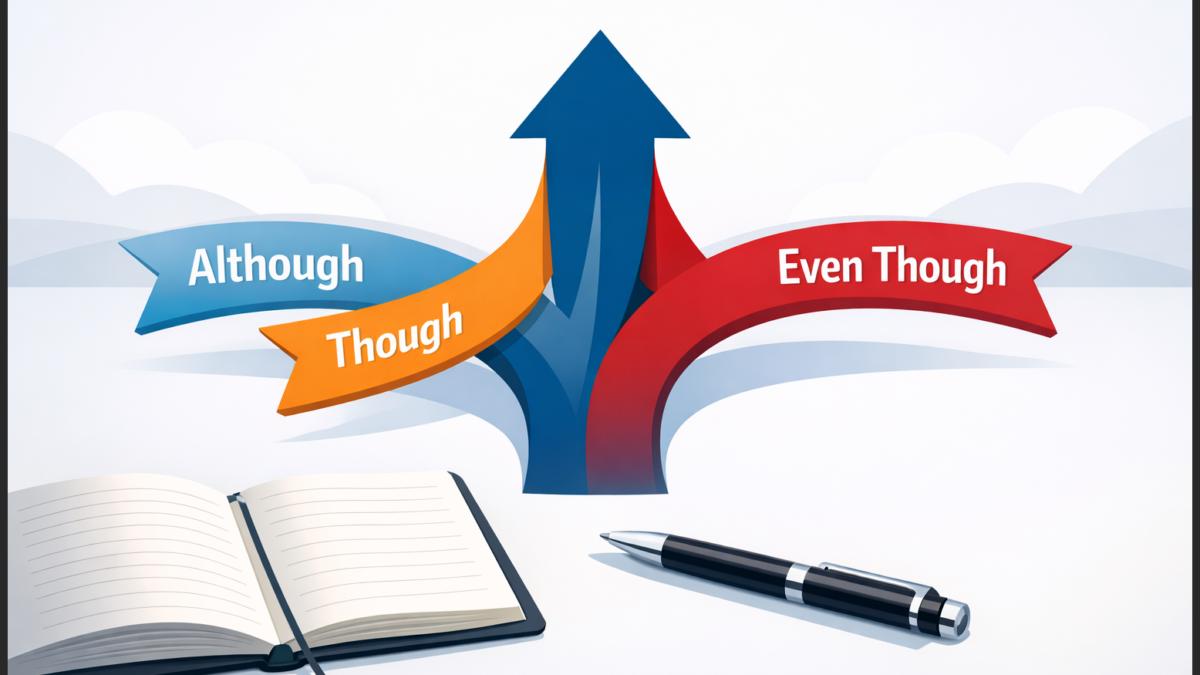
100 Examples of Although vs Though vs Even Though
- Although it rained, we went for a walk.
- It rained. We went for a walk, though.
- Even though it poured, we continued our hike.
- Though he was tired, he finished the assignment.
- He was tired. He finished the assignment, though.
- Although the book was long, I read it in one day.
- The task seemed difficult. We completed it on time, though.
- Even though she had studied, the test was challenging.
- Although I like him, I don’t agree with his methods.
- I don’t agree with his methods. I like him, though.
- Even though they warned us, we proceeded.
- Though cheap, the product was reliable.
- Although cheap, the product was reliable. (More formal)
- Even though it was cheap, the product was exceptional.
- She accepted the job, although the salary was low.
- The salary was low. She accepted the job, though.
- Even though the salary was low, she couldn’t refuse the offer.
- Although he apologized, she remained upset.
- He apologized. She remained upset, though.
- Even though he apologized sincerely, trust was broken.
- Though aware of the risks, he invested.
- Although aware of the risks, he invested.
- Even though he was fully aware of the risks, he invested.
- We enjoyed the trip, although the weather was bad.
- The weather was bad. We enjoyed the trip, though.
- Even though the weather was terrible, we had a great time.
- Although she is young, she is very wise.
- She is young. She is very wise, though.
- Even though she is much younger, she leads the team.
- Though I understand your point, I must disagree.
- Although I understand your point, I must disagree.
- Even though I see your logic, my decision is final.
- The food was cold, although it was still tasty.
- The food was cold. It was tasty, though.
- Even though the food was served cold, it was delicious.
- Although he practiced daily, he didn’t win.
- He practiced daily. He didn’t win, though.
- Even though he practiced relentlessly, victory eluded him.
- Though not perfect, the plan was solid.
- Although not perfect, the plan was solid.
- Even though it was far from perfect, the plan worked.
- I’ll help you, although I’m very busy.
- I’m very busy. I’ll help you, though.
- Even though my schedule is packed, I’ll make time.
- Although it’s late, I’m not tired.
- It’s late. I’m not tired, though.
- Even though it’s past midnight, I’m wide awake.
- Though a veteran, he was nervous.
- Although a veteran, he was nervous.
- Even though he was a seasoned veteran, anxiety crept in.
- The car is old, although it runs well.
- The car is old. It runs well, though.
- Even though the car is decades old, it runs perfectly.
- Although we lost, we played well.
- We lost. We played well, though.
- Even though we were the underdogs, we played brilliantly.
- Though he smiled, his eyes were sad.
- Although he smiled, his eyes were sad.
- Even though he wore a bright smile, his eyes betrayed his sorrow.
- I’ll try it, although I’m not hungry.
- I’m not hungry. I’ll try it, though.
- Even though I just had lunch, I’ll try that dessert.
- Although it’s a comedy, it has a deep message.
- It’s a comedy. It has a deep message, though.
- Even though it’s marketed as a comedy, it tackles serious issues.
- Though warned, he touched the hot surface.
- Although warned, he touched the hot surface.
- Even though he was repeatedly warned, he touched it.
- The room was small, although it was cozy.
- The room was small. It was cozy, though.
- Even though the room was tiny, it felt incredibly cozy.
- Although she failed, she learned a lot.
- She failed. She learned a lot, though.
- Even though she failed spectacularly, she gained valuable experience.
- Though expensive, it’s worth the price.
- Although expensive, it’s worth the price.
- Even though it costs a fortune, it’s worth every penny.
- He agreed, although reluctantly.
- He agreed. Reluctantly, though.
- Even though he vehemently opposed it initially, he finally agreed.
- Although the data is limited, trends are clear.
- The data is limited. Trends are clear, though.
- Even though the data is scarce, the trend is undeniable.
- Though I trust you, I need proof.
- Although I trust you, I need proof.
- Even though I trust you implicitly, protocol requires proof.
- The movie was long, although engaging.
- The movie was long. Engaging, though.
- Even though the movie was three hours long, it was thoroughly engaging.
- Although she’s quiet, she’s very observant.
- She’s quiet. She’s very observant, though.
- Even though she hardly speaks, she misses nothing.
- Though a beginner, she showed great skill.
- Although a beginner, she showed great skill.
- Even though she was a complete beginner, she outperformed others.
- We arrived on time, although traffic was heavy.
- Traffic was heavy. We arrived on time, though.
- Even though traffic was at a standstill, we arrived on time.
- Although he seems tough, he’s very kind.
- He seems tough. He’s very kind, though.
FAQs: Although vs Though vs Even Though
Q1: Can I use a comma after ‘but’ when I start a sentence with ‘although’?
A: No. Words like although, though, and even though already introduce a contrast, so using ‘but’ with them is redundant. Use one or the other. Correct: “Although it was cold, we went out.” Incorrect: “Although it was cold, but we went out.”
Q2: Is ‘though’ considered slang because it’s used at the end of a sentence?
A: Not slang, but informal. The sentence-final “though” is perfectly grammatical and common in conversational English, but it’s best avoided in very formal academic or business writing where “although” or “however” would be preferable.
Q3: Which is stronger: ‘although’ or ‘even though’?
A: Even though is stronger and more emphatic. It is used to highlight a more significant, surprising, or defiant contrast. “Even though” often stresses that the result is unexpected given the condition.
Conclusion: Although vs Though vs Even Though
Mastering the nuances of although vs though vs even though will significantly enhance the clarity and sophistication of your English communication. Remember, although offers formality, though provides flexibility, and even though delivers emphasis. By studying the rules and practicing with examples like the 100 provided, you can confidently navigate these common conjunctions in both writing and speech.
Disclaimer: This article is intended for educational purposes to explain general grammar rules. There may be rare stylistic exceptions in advanced literary contexts. For authoritative rulings in formal examinations, always refer to the specific guidelines provided.
Also Read: How to Use As Soon As and When: Master English Grammar with 100 Examples
As vs. Like: The Ultimate Guide on How to Use As and Like Correctly
About The Author
