Prepositions of Time At, On, and In
Mastering prepositions of time is crucial for clear communication. The three primary ones—at, on, and in—follow specific rules for referencing exact times, days, and longer periods. This guide provides a complete breakdown of prepositions of time at on in with extensive examples, essential tips for exam preparation, and answers to common queries to solidify your understanding.
Introduction:
Navigating the English language requires precision, especially when specifying when events occur. The correct use of prepositions of time at on in forms the bedrock of clear temporal communication. Misusing them can lead to confusion, while mastering them enhances both written and spoken fluency. This article serves as a comprehensive resource, offering clear rules, practical examples, and strategic insights to help you use these essential prepositions with confidence in any context.
Understanding Prepositions of Time: At, On, In
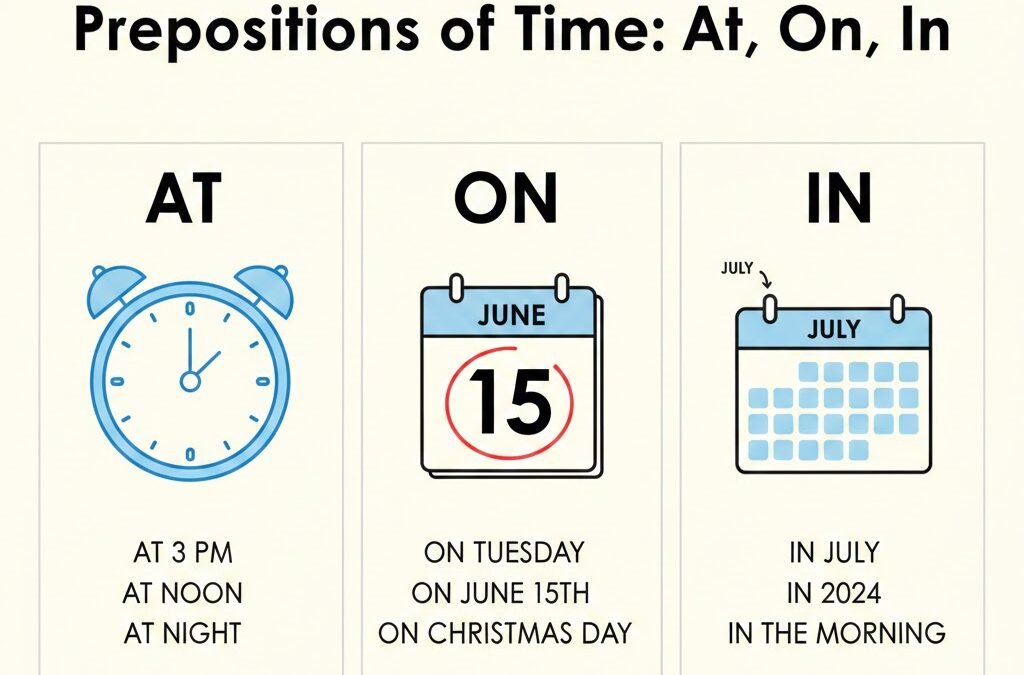
The core rule is based on specificity:
- AT is used for precise, clock-based times and specific points in the day.
- ON is used for specific days and dates.
- IN is used for longer, more general periods like months, years, seasons, and centuries.
100 Examples of Prepositions of Time At, On, In
AT (Precise Times)
- at 9:00 AM
- at noon
- at midnight
- at sunrise
- at sunset
- at the moment
- at bedtime
- at dinnertime
- at present
- at the same time
- at 17:30
- at the end of the hour
- at lunchtime
- at night (exception to “in” for general periods)
- at the weekend (common in British English)
ON (Days and Dates)
- on Monday
- on Tuesday morning
- on my birthday
- on December 25th
- on the weekend (common in American English)
- on New Year’s Day
- on that day
- on the first of July
- on a holiday
- on a weekday
- on the weekend
- on Saturday night
- on a summer day
- on your anniversary
- on the appointed day
- on time (punctual)
- on the deadline
- on schedule
- on his arrival
- on the eve of the election
IN (Longer Periods)
- in January
- in 2023
- in the 21st century
- in summer
- in the morning
- in the afternoon
- in the evening (but at night)
- in an hour
- in a minute
- in a week
- in the future
- in the past
- in the 1990s
- in the next decade
- in time (not late, with time to spare)
- in the meantime
- in the winter
- in early spring
- in late autumn
- in the first quarter
- in her childhood
- in his youth
- in the modern era
- in the Stone Age
- in a moment
Mixed and Combined Examples
- at 3 PM on Tuesday
- in July on the 4th
- on Monday at dawn
- in 2019 on a cold December night
- at midnight on New Year’s Eve
- on a rainy day in October
- in the morning at 6 o’clock
- at the start of the meeting on Friday
- in the 18th century on a typical farm
- on your birthday in the year you were born
- at noon on the dot
- in the late afternoon on weekends
- on a specific date in history
- at a precise moment in time
- on a beautiful day in spring
- in a year on this very date
- at present, in this difficult economic climate
- on schedule and in time for the launch
- in the evening on weekdays
- at the crack of dawn on the day of the race
- in my youth on the family farm
- on the hour at every meeting
- in a few minutes on the phone
- at a set time in the calendar
- on a public holiday in summer
- in the 1920s on a global scale
- at the appointed hour on the contract
- on the last day in office
- in the first week on the job
- at a later date in the proceedings
- on a daily basis in this clinic
- in the early hours of the morning on Sunday
- at the right time in your life
- on a regular basis in the past
- in due course on the matter
- at a time in the not-too-distant future
- on an annual basis in this industry
- in the blink of an eye on that fateful day
- at some point in the next century
- on this occasion in history
Important Tips for Exams and Competitive Tests
- The “Next/This/Last” Rule: When using words like next, last, this, every, and each, the preposition is often omitted. Say “See you next Monday,” not “on next Monday.”
- General vs. Specific: Remember the pattern from general to specific: IN (month) ON (day) AT (time). E.g., The event is in October on the 12th at 7 PM.
- Fixed Expressions: Memorize exceptions like at night, at the weekend (UK), on the weekend (US), in the morning/afternoon/evening, on time (= punctual), and in time (= not late, with time to spare).
- “In” for Future Time: “In” can mean “after a certain length of time.” E.g., “I will be ready in ten minutes.”
- Avoiding Common Errors: Do not use “on” before “all,” “every,” or “most.” Say “Most days,” not “On most days.” Do not use “at” before “today,” “tomorrow,” or “yesterday.”
FAQs on Prepositions of Time At, On, In
Q1: Why do we say “in the morning” but “at night”?
This is a historical exception that must be memorized. While “in” is used for parts of the day (in the morning/afternoon/evening), “at night” and “at noon/midnight” are fixed expressions using “at.”
Q2: Is it “on the weekend” or “at the weekend”?
Both are correct but depend on the dialect. “On the weekend” is standard in American English, while “At the weekend” is common in British English. Know your audience.
Q3: How do I know when to omit the preposition entirely?
Prepositions are often omitted before time words like next, last, this, every, each, and some. For example: “I’ll travel next month.” “She calls every Sunday.”
Conclusion: Prepositions of Time At, On, and In
Achieving grammatical accuracy hinges on understanding fundamental concepts like the prepositions of time at on in. By internalizing the rule of specificity—at for precise times, on for days, and in for longer periods—and practicing through examples, you can eliminate common errors. This knowledge is not only vital for daily communication but also a key differentiator in competitive examinations where every mark counts. Keep this guide handy for a quick refresher whenever you need to schedule your thoughts perfectly in time.
Disclaimer: This guide is for educational purposes and outlines standard rules for prepositions of time at on in. Regional dialects and evolving language use may present exceptions. For high-stakes examinations, always refer to the specific style guide or grammar rules prescribed by the examining authority.
Also Read: Lay vs Lie Present and Past: The Ultimate Guide to Conquering This Grammar Challenge
Everyday vs Every Day: Your Clear Guide to Perfect Usage
About The Author
