Mastering the difference between “your” and “you’re” is a cornerstone of polished English writing, yet it remains a common stumbling block. This guide provides an your vs you’re easy explanation to eliminate confusion for good. With clear definitions, memorable tricks, and extensive examples, you’ll quickly learn to use these homophones correctly and boost your confidence in any professional or academic setting.
Introduction to Your vs You’re
If you’ve ever paused while typing, unsure whether to use “your” or “you’re,” you’re not alone. This classic grammar dilemma trips up many writers, but the solution is simpler than you think. This article delivers the ultimate your vs you’re easy explanation, breaking down the rule into a foolproof test you can apply in seconds. Understanding this distinction is more than just correct grammar—it’s essential for clear communication in emails, exams, and professional documents.
The Core Your vs You’re Easy Explanation
The confusion stems from the fact that “your” and “you’re” are homophones; they sound identical but have completely different meanings and functions.
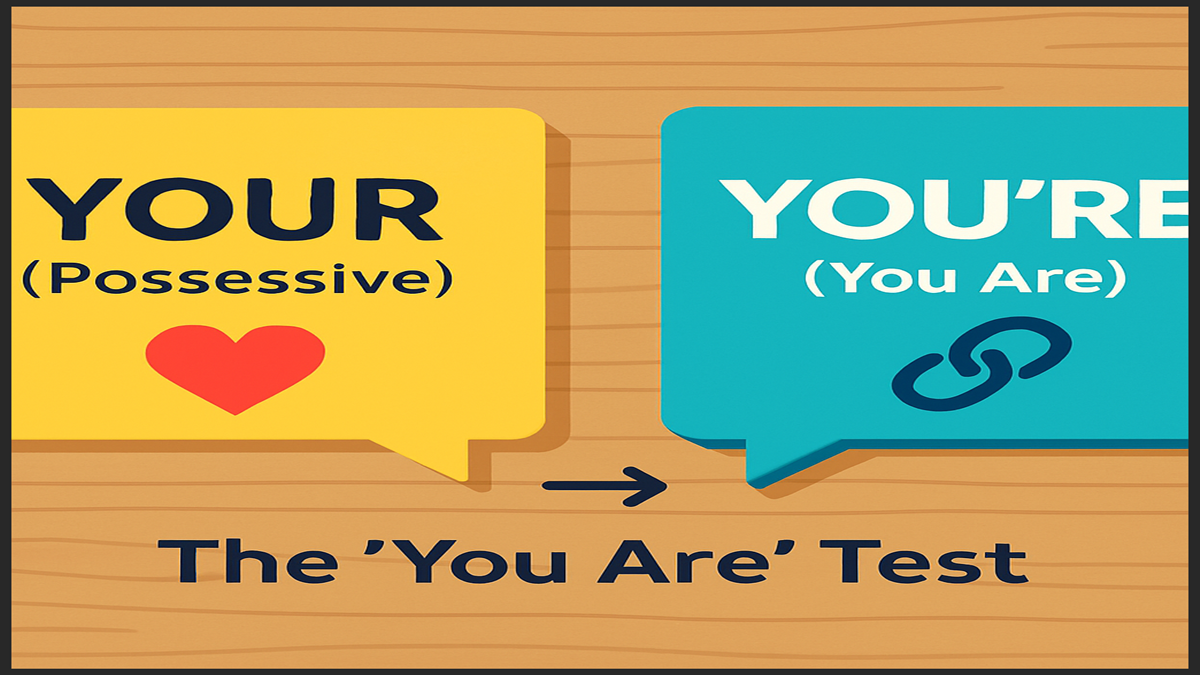
- You’re is a contraction, a shortened form of two words: “you are.” The apostrophe replaces the missing letter a.
- Example: “I think you’re (you are) going to love this movie.”
- Your is a possessive adjective. It always shows that something belongs to or is associated with “you”.
- Example: “Is this your notebook?”
The Foolproof Substitution Test
The easiest way to check which word is correct is the substitution test.
- Read your sentence.
- Replace the questionable word with “you are.”
- If the sentence still makes sense, use you’re.
- If it becomes nonsense, use your.
Test in Action:
- Sentence: “Is that your/you’re umbrella?”
- Substitution: “Is that you are umbrella?” Incorrect: (Nonsense)
- Correct answer: “Is that your umbrella?” Correct
100 Examples of Your vs You’re
Here are 100 contextual examples to solidify your understanding.
Examples with “Your” (Possession)
- Your dedication is impressive.
- Please submit your report by Friday.
- Is this your first time here?
- I love your new haircut.
- The choice is yours.
- Your account has been activated.
- Can I borrow your pen?
- Your feedback is valuable to us.
- What is your phone number?
- Keep your belongings safe.
- Your patience is appreciated.
- Follow your instincts.
- I’ve read your article.
- Your happiness matters.
- Sign your name on the line.
- Is this your car key?
- Your opinion counts.
- Please check your email.
- I admire your courage.
- What are your plans for the weekend?
- Your dinner is getting cold.
- This is your responsibility.
- I’ve missed your smile.
- Your application is under review.
- Tell me about your day.
- Your seat is in the front row.
- I need your help with this.
- What’s your favorite book?
- Your loyalty means a lot.
- Is that your final answer?
- Please state your name.
- Your jacket is on the chair.
- I value your friendship.
- Enter your password below.
- Your success is our priority.
- Watch your step.
- I’ve heard a lot about your work.
- Your efforts will pay off.
- Is he your brother?
- Your confidence is inspiring.
- Clean your room.
- I respect your decision.
- Your order is on its way.
- What’s your major?
- Your health is important.
- I can see your point.
- Update your profile picture.
- Your kindness is noted.
- Is this your dog?
- Follow your dreams.
Examples with “You’re” (You are)
- You’re doing a great job.
- I think you’re absolutely right.
- You’re welcome to join us.
- It seems you’re very busy today.
- You’re the best person for this task.
- I hope you’re feeling better.
- You’re looking very smart.
- Tell me when you’re ready.
- You’re going to love this surprise.
- I know you’re capable of more.
- You’re not alone in this.
- If you’re hungry, there’s food in the kitchen.
- You’re always so helpful.
- I heard you’re moving to a new city.
- You’re making excellent progress.
- You’re sure about this, right?
- You’re invited to the meeting.
- I believe you’re mistaken.
- You’re too kind.
- You’re the one I was looking for.
- It’s obvious you’re a natural leader.
- You’re running late.
- You’re in charge now.
- I can tell you’re excited.
- You’re almost there!
- You’re better than this.
- You’re free to leave whenever.
- You’re on the right track.
- I see you’re wearing the gift I gave you.
- You’re a true inspiration.
- You’re supposed to be in class.
- You’re my best friend.
- You’re under no obligation.
- You’re taller than I remember.
- You’re facing the wrong direction.
- You’re very thoughtful.
- You’re next in line.
- You’re smarter than you think.
- You’re late for the appointment.
- You’re the reason we succeeded.
- You’re blowing this out of proportion.
- You’re a valuable member of the team.
- You’re not listening to me.
- You’re all set.
- You’re driving too fast.
- You’re required to attend.
- You’re making a big difference.
- You’re off to a great start.
- You’re standing in my light.
- You’re going to do amazing things.
Tips for Students and Exam Candidates
Making the “your/you’re” error can undermine your credibility in high-stakes situations. Here’s how to master it for exams and professional writing:
- The Mental Read-Aloud Trick: During exams, especially in essay sections, silently “read aloud” the sentence in your head using “you are.” This quick check takes seconds but can catch costly errors.
- Understand Why It Matters: Competitive exams (like SAT, GRE, GMAT, and civil service tests) often include grammar sections that test homophones. A single error can affect your score. In professional settings, such mistakes can make your writing appear careless.
- Practice with Purpose: Don’t just memorize the rule—actively apply it. Use the examples above to create your own sentences. The goal is to make the correct choice automatic.
- Beware of Apostrophe Pitfalls: Remember, an apostrophe in “you’re” indicates missing letters, not possession. This is the opposite of how apostrophes are often used (e.g., “Sarah’s book”). Keeping this distinction clear will help you avoid the mistake.
FAQs About Your vs You’re
Q1: Why do even native English speakers mix up “your” and “you’re”?
A: Primarily because they are homophones—they sound exactly the same when spoken. In fast typing or informal writing (like texts), the brain often relies on sound, leading to the error. This makes learning the visual distinction and applying the substitution test crucial.
Q2: Is “your” ever used in a non-possessive way?
A: Yes, “your” can be used idiomatically or formally to mean “associated with you,” not strictly ownership. For example: “Your average student knows this rule,” or “With your permission, I’ll proceed.” The key is that it still relates to “you” and would not pass the “you are” substitution test.
Q3: What’s the fastest way to proofread for this error?
A: Use the Find function (Ctrl+F / Cmd+F) in your document. Search for “your” and “you’re” individually. For every instance, pause and perform the quick “you are” substitution test to verify it’s correct. This targeted method is much more efficient than reading the entire text hoping to spot the error.
Conclusion on Your vs You’re
Mastering “your” and “you’re” is a simple yet powerful step toward flawless writing. As this your vs you’re easy explanation has shown, the cornerstone rule—substituting “you are”—is a quick and reliable tool you can use anywhere. Consistent practice will transform this rule from a conscious check into an unconscious habit, ensuring your writing is always clear, professional, and correct.
Disclaimer on Your vs You’re
This article provides general guidance on English grammar rules. While the explanations and examples are designed for accuracy and clarity, specific style guides (e.g., APA, MLA, Chicago) or institutional guidelines may have additional nuances. For formal academic or publication purposes, always consult the relevant style manual.
Also Read: The Semicolon Solved: A Clear Guide on When to Use a Semicolon
Beside vs Besides Grammar Usage: 100 Practice Sentences
About The Author
