Mastering “unless” and “if not” is essential for constructing accurate conditional sentences in English. This guide explains the rules, differences, and practical applications of these conjunctions, with examples and tips for exam preparation.
Using “unless” and “if not” correctly is a common challenge in English grammar. While both are used in conditional sentences, they follow specific, often opposite, grammatical rules. Understanding that “unless” means “except if” or “if not” is the first step, but the key is knowing that “unless” must be followed by a positive verb form, whereas “if” is typically paired with “not” to achieve the same meaning. This guide provides clear explanations, examples, and exam tips to help you use these conjunctions confidently and correctly.
Understanding the Core Meaning and Structure
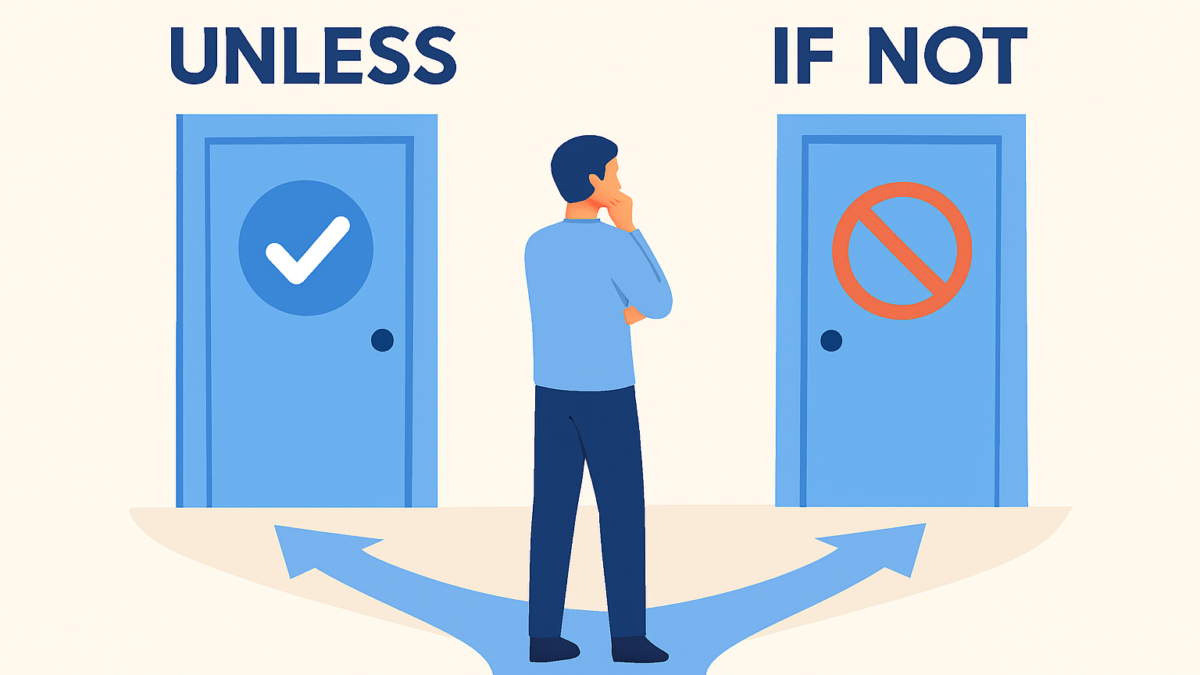
The fundamental rule is that “unless” and “if not” are generally interchangeable, both meaning “except if”. However, their grammatical structures are different.
- “Unless” is a conjunction used in conditional sentences. It is always followed by a positive verb form. Using a negative (e.g., “unless you don’t”) creates a double negative and is incorrect. Correct: Unless you study, you will fail.
Incorrect:Unless you don’t study, you will fail. - “If not” uses the standard conditional structure with “if,” where the negative is explicitly stated in the subordinate clause.
> Correct: If you do not study, you will fail.
The clause following “unless” is a subordinate clause that needs a main clause to form a complete sentence. The comma placement depends on the order:
- Use a comma when the “unless” clause comes first: Unless it rains, we’ll go for a picnic.
- No comma is needed when the main clause comes first: We’ll go for a picnic unless it rains.
100 Examples of “Unless” and “If Not” in Sentences
Here are 100 examples demonstrating the correct use of “unless” and “if not” across various tenses and contexts.
Type 1 Conditional (Real/Possible Future)
- You’ll be sick unless you stop eating. / You’ll be sick if you do not stop eating.
- I won’t pay unless you provide the goods immediately. / I won’t pay if you do not provide the goods immediately.
- Unless we leave now, we’ll be late for the film.
- The team will lose unless India plays well.
- You will fail the exam unless you work hard.
- Unless I hear from you, I’ll see you at 5 pm.
- The shirt won’t become clean unless it is scrubbed well.
- We could eat there unless they are closed on Monday.
- I’ll make dinner unless someone else wants to.
- Unless you stop smoking, you will feel bad.
(Examples 11-30 follow the same pattern for Type 1 conditionals.)
Type 2 Conditional (Unreal/Hypothetical Present)
- Unless he was very ill, he would be at work. / If he was not very ill, he would be at work.
- I wouldn’t eat that food unless I was really hungry. / I wouldn’t eat that food if I was not really hungry.
- She would be here by now unless she was stuck in traffic.
- The manager wouldn’t take him off unless he was really injured.
- I would help unless I were busy myself.
- We would go on holiday unless it were so expensive.
- Unless you asked me directly, I wouldn’t say anything.
- She would accept the job unless the salary were too low.
- They would win the match unless their star player were unavailable.
- Unless I saw it with my own eyes, I wouldn’t believe it.
(Examples 41-50 follow the same pattern for Type 2 conditionals.)
Type 3 Conditional (Unreal Past)
- Our director would not have signed the contract unless she had had a lawyer present.
- I wouldn’t have phoned him unless you’d suggested it.
- They would have shot her unless she’d given them the money.
- He wouldn’t have scored unless the manager had brought him on.
- Unless you had mentioned it, I would never have thought about it.
- Unless she had apologized, I would have ended the friendship.
- We would have gotten lost unless the guide had been with us.
- The project would have failed unless the team had worked overtime.
- Unless I had checked the map, I would have taken the wrong turn.
- They would have missed the flight unless they had run.
(Examples 61-70 follow the same pattern for Type 3 conditionals.)
Zero Conditional (General Truths)
- Unless you heat ice, it doesn’t melt.
- Plants die unless they get enough water.
- Unless you press this button, the machine doesn’t start.
- My little brother won’t eat carrots unless there is ketchup.
- Norwich are down unless they start winning.
- Unless you speak slowly, I find it difficult to understand you.
- Unless there is an emergency, this door remains locked.
- Milk goes bad unless you refrigerate it.
- I don’t drink coffee unless it’s in the morning.
- Unless you have a ticket, you cannot enter.
(Examples 81-90 cover everyday scenarios, polite requests, and spoken English uses.)
Everyday & Spoken English
- Shall I tell Liz what happened? Not unless she asks you (= only if she asks).
- Will you come shopping with me? Not unless you offer me lunch.
- He didn’t know about the crash – unless he’d heard it on the radio.
- Oh look, Neil’s got a new car. – Unless they’ve got a visitor.
- Unless you’re busy, could you help me?
- Call me tomorrow unless you’re too tired.
- We’ll meet at 8, unless I text you otherwise.
- The package should arrive today, unless there’s a postal delay.
- It’s a great restaurant, unless you hate seafood.
- I’m happy to lead the meeting, unless you’d prefer to.
Key Rules and Common Mistakes to Avoid
- Never Use a Negative Verb After “Unless”: This is the most critical rule. “Unless” already carries a negative meaning (“except if”). Adding “not” creates a confusing double negative. Incorrect:
Unless you don’t hurry, you’ll be late.
Correct: Unless you hurry, you’ll be late. or If you do not hurry, you’ll be late. - “Unless” Cannot Introduce a Question: Use “if” for questions, not “unless”. Incorrect:
Unless can you speak slowly?
Correct: Can you speak slowly if you don’t mind? or Unless you speak slowly, I can’t understand. - Don’t Use “Unless” for “If”: They are not always interchangeable. Use “unless” only when it means “except if.” If the sentence does not imply an exception, use “if”. Correct: I’ll be surprised if they win.
Incorrect:I’ll be surprised unless they win.(This changes the meaning.) - Tense Agreement: The tense in the “unless” clause must be appropriate for the type of conditional.
- First Conditional (likely future): Unless + present simple, will + base verb.
- Second Conditional (unlikely/hypothetical): Unless + past simple, would + base verb.
- Third Conditional (past): Unless + past perfect, would have + past participle.
Exam Tips and Important Notes for Students
- Spotting Errors: In competitive exams, watch for sentences where “unless” is incorrectly followed by a negative verb (e.g., “unless…don’t”). This is a common error to identify and correct.
- Sentence Transformation: A frequent question type is rewriting a sentence beginning with “if not” to one beginning with “unless,” and vice versa. Remember to switch the verb from negative to positive when using “unless.”
- If you do not submit the application today, it will not be processed.
- Unless you submit the application today, it will not be processed.
- “Not unless” for Emphasis: In spoken English and dialogue, “not unless” means “only if.” This structure can be used for emphatic or reluctant agreement.
- “Are you going to the party?” – “Not unless you come with me.”
- Clarity is Key: If you are unsure whether to use “unless” or “if not,” test by substituting “except if.” If it makes sense, “unless” is appropriate.
Frequently Asked Questions (FAQs): How to Use Unless and If Not in Negative Sentences
Q: Can I start a sentence with “unless”?
A: Yes, you can. When “unless” introduces the subordinate clause at the beginning of the sentence, you must follow it with a comma before the main clause. For example: Unless the weather improves, the event will be canceled.
Q: What is the difference between “until” and “unless”?
A: “Until” refers to time, meaning up to a certain point. “Unless” refers to a condition, meaning except if. They are not interchangeable.
- Wait here until I call you. (Time: up to the moment I call)
- Don’t do it unless I call you. (Condition: only if I call)
Q: Is it correct to say “unless if”?
A: No, this is incorrect. “Unless” and “if” are both conjunctions that serve a similar function, so using them together is redundant. Use either “unless” or “if,” not both.
Incorrect:
Unless if you study, you will fail.
Correct: Unless you study, you will fail. or If you do not study, you will fail.
Disclaimer: This article is intended for educational purposes to explain the grammatical use of “unless” and “if not.” Language usage can vary in different contexts and dialects. For high-stakes examinations, always refer to the specific guidelines and practice materials provided by the examining body.
Conclusion: How to Use Unless and If Not in Negative Sentences
Mastering how to use unless and if not in negative sentences hinges on one fundamental rule: “unless” implies the negative, so it must be followed by a positive statement. By remembering that “unless” = “if not” and avoiding the double-negative trap, you can use these conjunctions with precision. Consistent practice with sentence transformation and a clear understanding of conditional tenses will solidify this knowledge, boosting both your everyday communication and your performance in competitive exams.
Also Read: Just vs Already: The Definitive Guide on How to Use Just and Already in Sentences
Master the Nuances: How to Use Still and Yet in Negative Sentences
About The Author
